
Installing a shelf on a drywall, replacing a faucet seal, shortening a door that sticks: every home project starts with the same instinct, checking what tools are at hand. The choice of DIY tools determines the quality of the result and the time spent on the project. It’s better to have a limited number of suitable tools than a drawer full of vague references.
Single battery or multi-brand: the choice that structures the entire workshop
Before discussing hammers or screwdrivers, we address the question that costs the most in the long run: the power supply for cordless tools. Buying a drill-driver from one brand and then a jigsaw from another means ending up with three chargers, three battery formats, and an unnecessarily inflated budget.
Manufacturers now offer ecosystems where a single battery powers the entire range. You choose your first machine, get the battery, and each subsequent tool is purchased in a “bare” version (without battery or charger), which significantly reduces the bill.
The Cordless Alliance System (CAS) takes this logic further: it brings together over thirty manufacturers (Metabo, Mafell, Rothenberger, among others) around a common battery format. You can check Cécile Bricole’s equipment to get an idea of the possible combinations between compatible brands. The principle remains the same: locking in a battery format from the start avoids paying twice.
Brushless drill-driver: why the motor changes the game
The cordless drill-driver remains the most requested tool in a home workshop. It is used for drilling wood, screwing particle board, and anchoring a plug into lightweight concrete. The selection criterion that makes the difference today is the type of motor.

Brushless motors, long reserved for professional ranges, now equip drills accessible to regular DIYers. Their advantages are threefold:
- The absence of brushes eliminates the main wear part, significantly extending the machine’s lifespan.
- Energy efficiency is better: the battery lasts longer between charges, which is a practical point when drilling multiple holes in a day.
- The torque is better managed electronically, reducing jerks at startup and providing more precision in soft materials like drywall or softwood.
However, feedback varies on the price difference. On an entry-level drill, the gap between a brushed model and a brushless model may seem disproportionate if you only DIY twice a year. For monthly or more frequent use, the additional cost is justified by longevity.
Hand tools for DIY: the five that are useful for every project
You don’t need twenty hand tools to cover most domestic situations. Five are sufficient if chosen correctly.
The carpenter’s hammer (with a fiber or steel handle and a medium-sized head) is suitable for driving nails, adjusting pieces, and light disassembly thanks to its integrated claw. A model that is too heavy tires the wrist, while one that is too light requires harder strikes: you want an intermediate weight that feels natural.
The set of screwdrivers, both flat and Phillips, is more reliable than a screwdriver with interchangeable bits for common uses. The bits often slip in slightly stuck screws, where a dedicated screwdriver holds the imprint better. Three sizes of each type cover nearly all household screws.
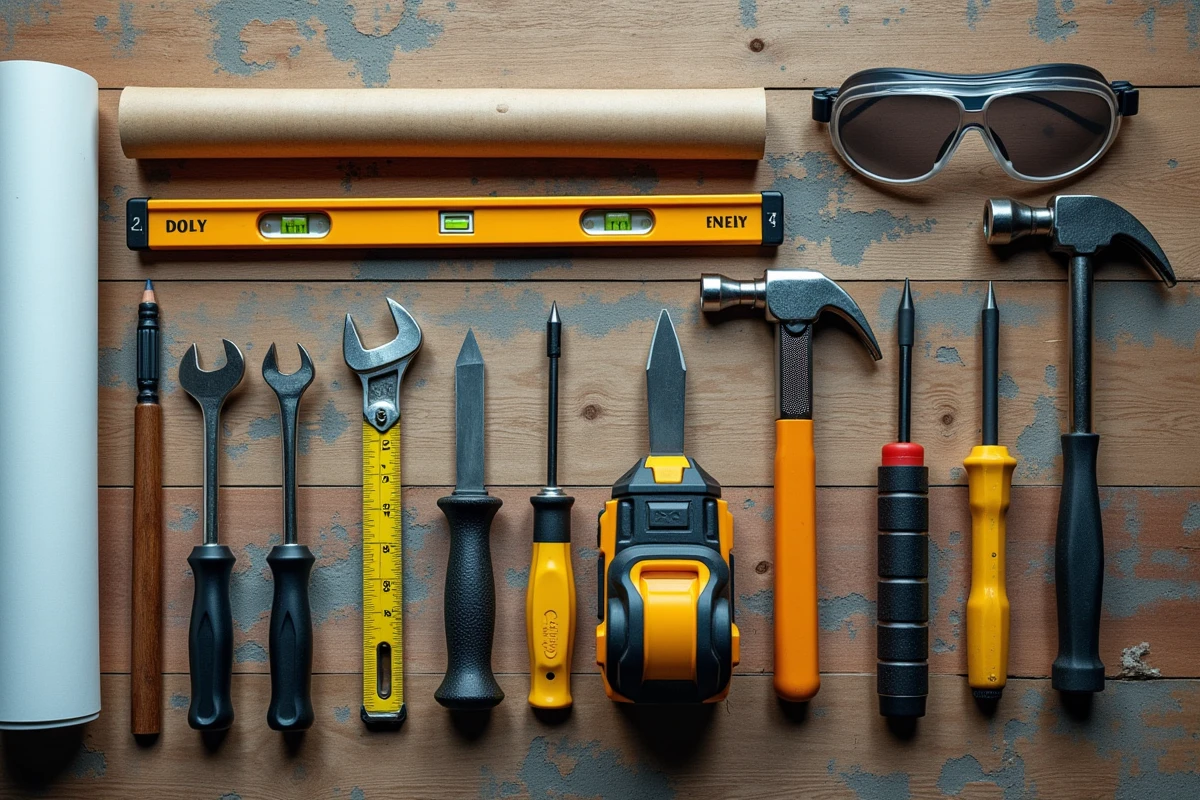
The five-meter tape measure with automatic locking is sufficient for most rooms. It is complemented by a compact spirit level, which fits into a work pants pocket. Installing a shelf without a level guarantees a visible misalignment as soon as an object is placed on it.
The adjustable pliers close the list. They are used to hold, tighten, turn nuts, or loosen a plumbing fitting. A model with a push-button adjustable opening avoids having to reposition the knob with each change of diameter.
Saw and cutting: adapting the blade to the material
The hand saw remains the most accessible cutting tool for wood. A fine tooth gives a clean cut on battens and thin boards. For thicker cuts or particle boards, a cordless jigsaw takes over with considerable time savings.
A common pitfall is using the same blade for everything. A wood blade in metal heats up and warps. A metal blade in wood tears the fibers instead of cutting them. It’s advisable to stock at least two types of blades (wood, metal) and check compatibility with the saw’s fixing system.
The retractable blade cutter completes the cutting equipment for soft materials: cardboard, carpet, plastic film, seals. The blade should be changed as soon as it pulls instead of cutting, which happens faster than one might think.
Protection and ergonomics: what we systematically forget
Safety glasses cost a few euros and protect against concrete splinters or sawdust projections. They should be worn whenever drilling, sawing, or grinding. Work gloves should be snug: a glove that is too loose reduces grip and can get caught in a rotating tool.
The INRS reminds us that the ergonomics of tools directly influences the risk of musculoskeletal disorders, even in occasional DIY. The weight of the machine, balance, and the shape of the handle are as important as power. Recent ranges incorporate these parameters into their design, with lighter machines and anti-vibration handles.
A final often overlooked point: storage. A tool that lies at the bottom of a box deteriorates, gets lost, and ends up being repurchased. A compartmentalized toolbox or a perforated wall panel keeps each piece visible and accessible. You can spot at a glance what is missing before starting a project, avoiding wasting twenty minutes searching for the right drill bit.